[填空题]
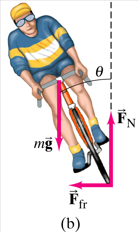
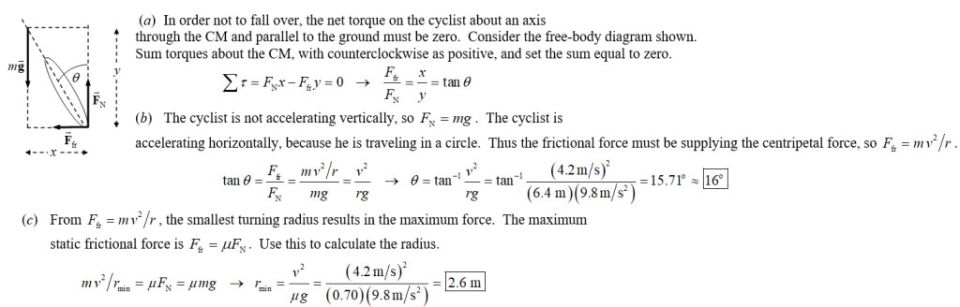
A bicyclist traveling with speed v=4.2m/v br9*d9d sm8fizq3dn;mv:c, ii )hd 6s on a flat road is making a turn witho v/g,dkh3( eh5 c4ivl a radius The forces acting on the cyclist iv5h3ghodel 4(c,v/kand cycle are the normal force $\left(\mathbf{\vec{F}}_{\mathrm{N}}\right)$ and friction force $\left(\mathbf{\vec{F}}_{\mathbf{fr}}\right)$ exerted by the road on the tires, and $m\vec{\mathbf{g}}$ the total weight of the cyclist and cycle (see Fig. 8–56). (a) Explain carefully why the angle $\theta$ the bicycle makes with the vertical (Fig. 8–56) must be given by tan $\tan\theta=F_{\mathrm{fr}}/F_{\mathrm{N}}$ if the cyclist is to maintain balance.(round to the nearest integer) (b) Calculate $\theta$ for the values given. $^{\circ} $ (c) If the coefficient of static friction between tires and road is $\mu_s=0.70$ what is the minimum turning radius? m



 Post time 2025-3-3 09:18:36