[填空题]
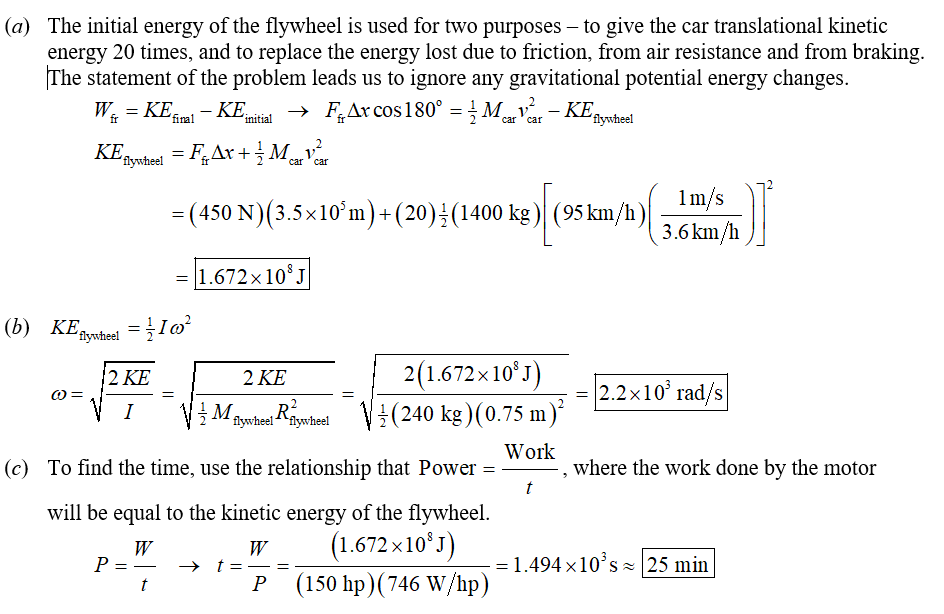
One possibility for e r; g1dawfyxva ;p0,z7)hnz :akq*e9mm.n6.n+8q s md cqo3tt low-pollution automobile is for it to use energy stored in a heavy rotating flywheel. Suppose such a car has a total mass of 1400 kk nmqe m.qm6qs3 +t*o9ct8n.d g, uses a uniform cylindrical flywheel of diameter 1.50 m and mass 240 kg, and should be able to travel 350 km without needing a flywheel “spinup.” (a) Make reasonable assumptions (average frictional retarding force = 450N twenty acceleration periods from rest to equal uphill and downhill, and that energy can be put back into the flywheel as the car goes downhill), and show that the total energy needed to be stored in the flywheel is about $ 1.7\times10^{8 }$J. $ \times10^{ 8}$ J (b) What is the angular velocity of the flywheel when it has a full “energy charge”? $rad/s$ (c) About how long would it take a 150-hp motor to give the flywheel a full energy charge before a trip? $\approx$ min



 Post time 2025-2-18 20:00:22